
Today, ShengShu Technology officially launched Motubrain, a General World Action Model. As an important milestone in the company’s world-model roadmap, Motubrain is designed as a general-purpose brain for embodied robots. It supports multiple robot embodiments, generalizes across tasks, and executes long-horizon workflows, enabling robots to complete continuous and complex tasks more reliably in homes, factories, commercial environments, and other real-world settings.
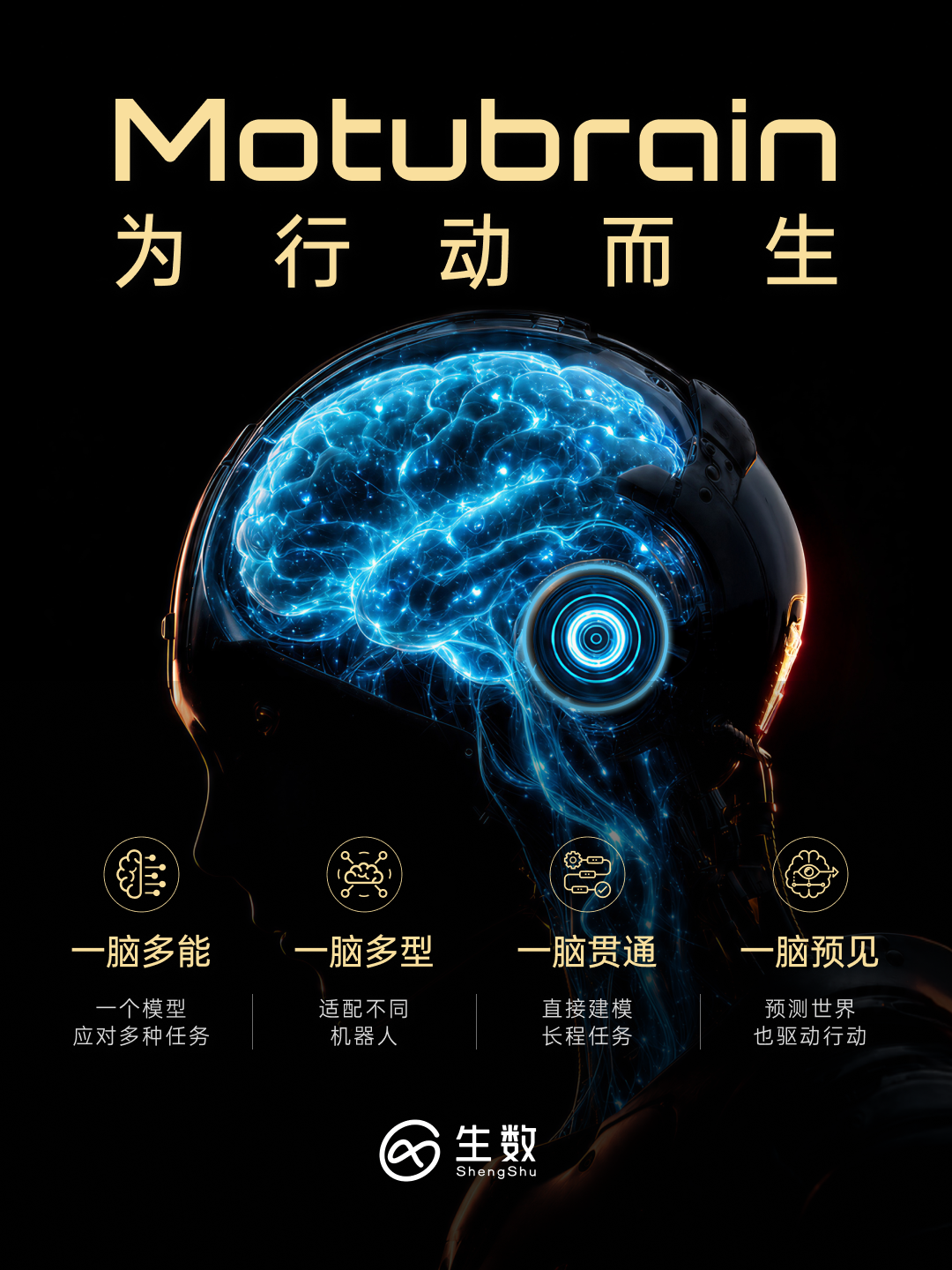
Motubrain’s central breakthrough is to model the world a robot sees and the actions it needs to take within one unified model. This allows a robot not only to understand its environment, but also to imagine and predict how that environment may change and to generate executable action strategies.
Built on ShengShu Technology’s original UniDiffuser framework, Motubrain jointly models video and action as two continuous modalities. It learns the relationships among environmental change, action execution, and task outcomes. A single training process supports VLA, video generation, inverse-dynamics modeling, and joint video-action prediction, without relying on separate models for perception, prediction, planning, and execution.
Motubrain further introduces a three-stream Mixture-of-Transformers architecture for video, action, and language. By combining existing multimodal pretrained models with expert models, it can understand scenes, follow language instructions, predict outcomes, and generate actions at the same time. Unlike traditional pipelines whose perception, planning, and execution stages are disconnected, Motubrain links the complete task chain through one architecture, strengthening semantic understanding, instruction following, and end-to-end action.
Unified modeling also enables Motubrain to keep learning from a broader range of data. In addition to complete robot task trajectories, it can use videos without action labels, task-agnostic data without language instructions, and video, action, and language data from different robot embodiments. Traditional VLA systems depend heavily on task trajectories collected for specific robots; Motubrain breaks through this data wall, makes use of large-scale heterogeneous data, and offers stronger scalability and generalization.
Motubrain therefore goes beyond teaching robots how to execute actions. Its goal is to help them understand the world, predict the world, and act upon it. Four core capabilities support this goal.
One Brain, Many Tasks
Motubrain maintains stable performance across multi-task scenarios instead of being confined to a single training task. As the number of tasks grows, shared world knowledge increases and average task success improves, demonstrating stronger unified multi-task capability and generalization.
One Brain, Many Embodiments
Motubrain is not tailored to one robot. It is a unified intelligence foundation designed for multiple robot embodiments, replacing the traditional one-robot-one-model pattern. It can learn effectively from heterogeneous data. As the ecosystem expands across robot types, scenarios, and datasets, the model can continue improving and transfer those gains back to every robot category in the ecosystem.
One Brain for Complete Long-Horizon Tasks
Motubrain learns complete task chains directly, without requiring upper-level planning, task decomposition, fast-slow dual systems, or multiple stitched-together models. A single World Action Model can complete complex long-horizon tasks containing ten atomic actions, rather than stopping at demonstrations of only two or three. The robot is no longer handling isolated actions; it is continuously advancing an entire closed-loop task.
One Brain that Anticipates and Decides
Motubrain does more than execute instructions. It understands the world, predicts environmental change, and uses those predictions to infer more appropriate actions and motion paths. By unifying world understanding, world prediction, and action execution, it can continuously assess, adjust, and act in dynamic scenes—predicting the world while driving action.
These capabilities extend beyond a single environment. In homes, Motubrain can support continuous tasks such as meal preparation, tidying, and assistance. In industrial settings, it can adapt to sorting, transport, assembly, and other complex workflows. In commercial settings, it can support navigation, pickup and delivery, shelf organization, and coordinated services across multiple steps.
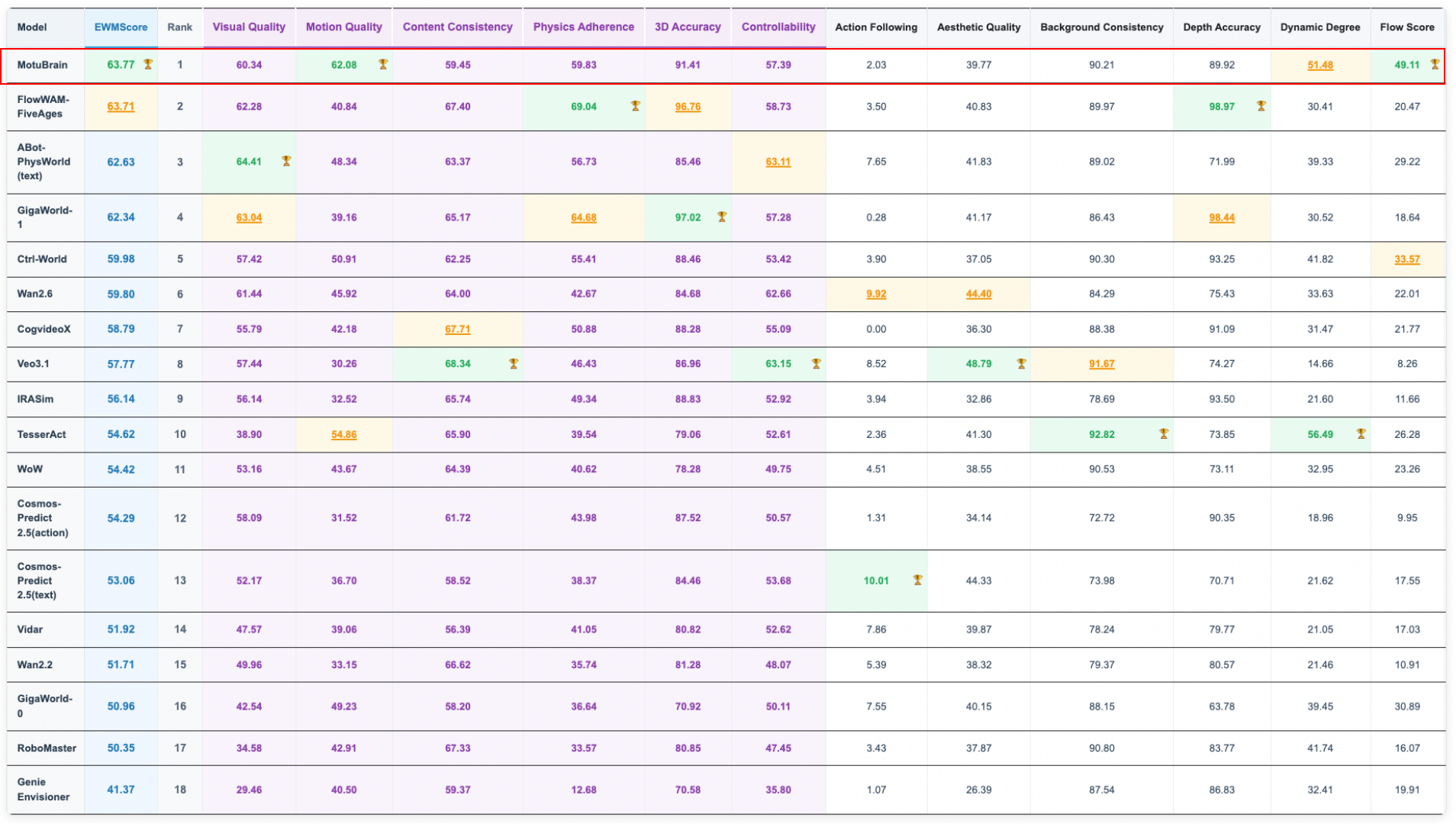
Motubrain now ranks first on both WorldArena and RoboTwin 2.0, two internationally recognized benchmarks. The results validate the feasibility of unifying world prediction with action generation and mark another step in moving a general-purpose physical brain from technical exploration toward real-world deployment.
First on Two Benchmarks: Predicting and Acting in the World
The most striking result of the Motubrain launch is its simultaneous first-place performance on two authoritative benchmarks that have long represented opposite ends of embodied intelligence. WorldArena focuses on world-model capability and whether a model truly understands and predicts physical laws. RoboTwin 2.0 focuses on robotic execution, evaluating performance and generalization across complex, randomized environments.
Although the benchmarks appear to test different directions, together they capture the two central capabilities of embodied intelligence: understanding and predicting the world, and entering and acting upon it.
On WorldArena, Motubrain ranked first in key dimensions including Motion Quality, Flow Score, and Motion Smoothness, demonstrating a deep understanding of real physical motion.
On RoboTwin 2.0, Motubrain achieved an average score of 96.0 across 50 complex tasks. It is the only model on the leaderboard with an average above 95 in randomized environments, demonstrating exceptional execution stability and cross-scenario generalization.
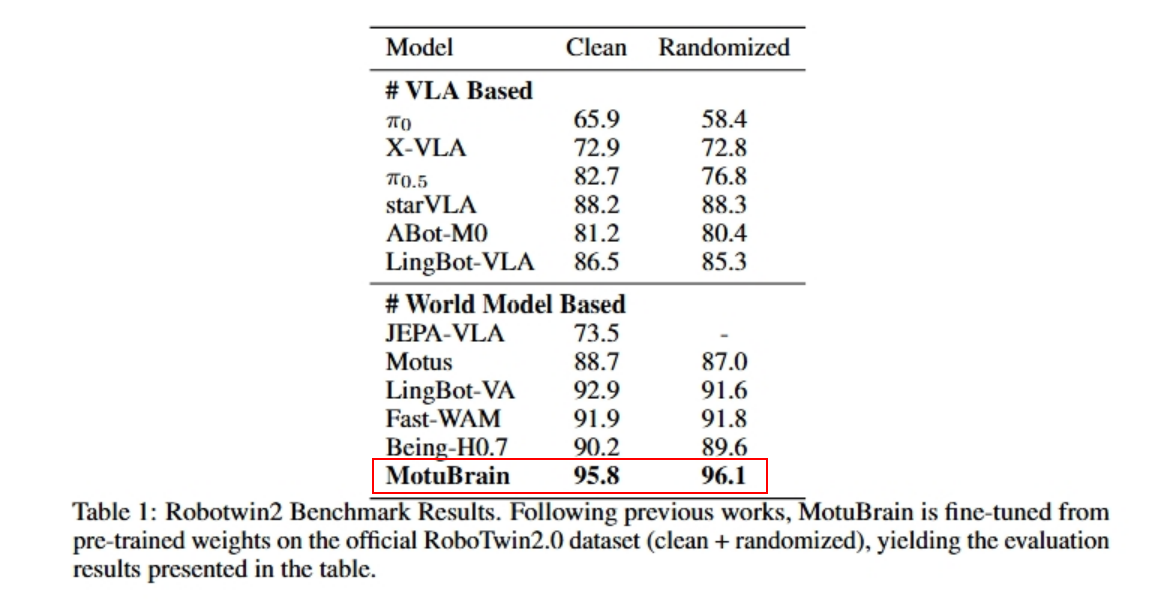
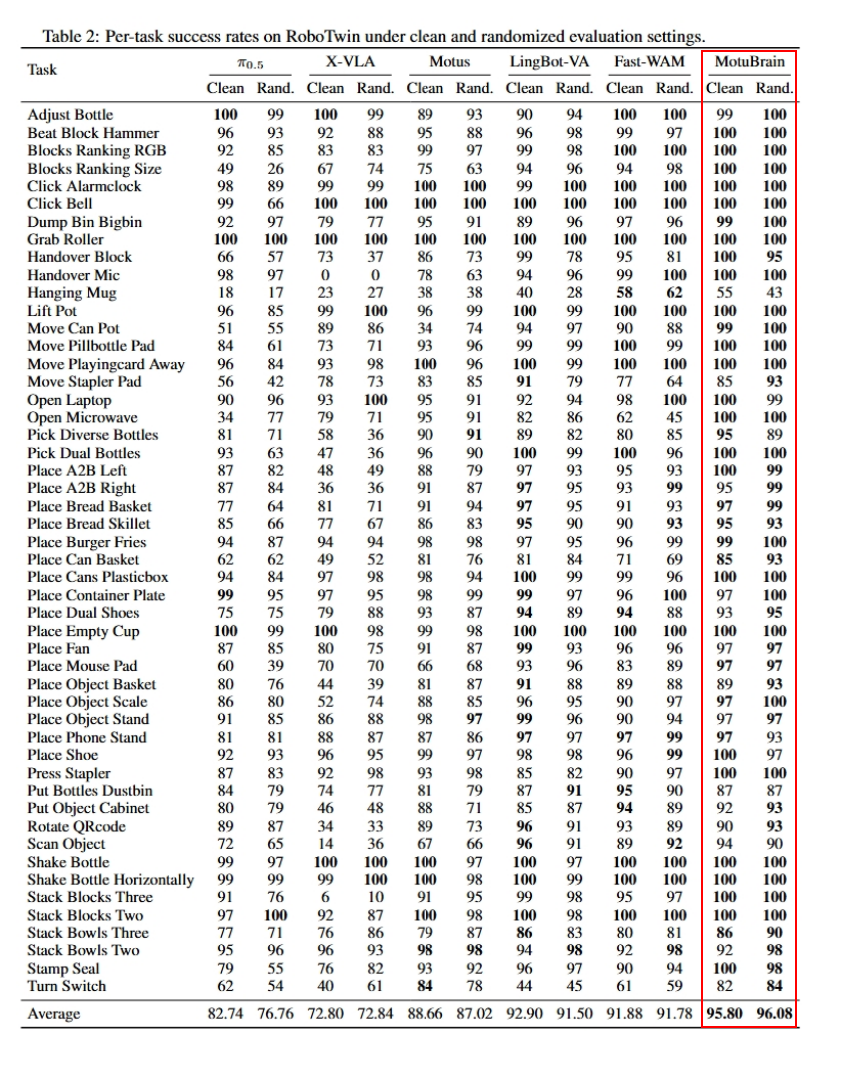
Motubrain’s lead is therefore not limited to a single capability. Within one model framework, it more systematically unifies understanding the world with driving action, closing the technical gap between systems that can see but cannot act and those that can act without anticipation.
From Motus to Motubrain: World Action Models as a New Path for Embodied Intelligence
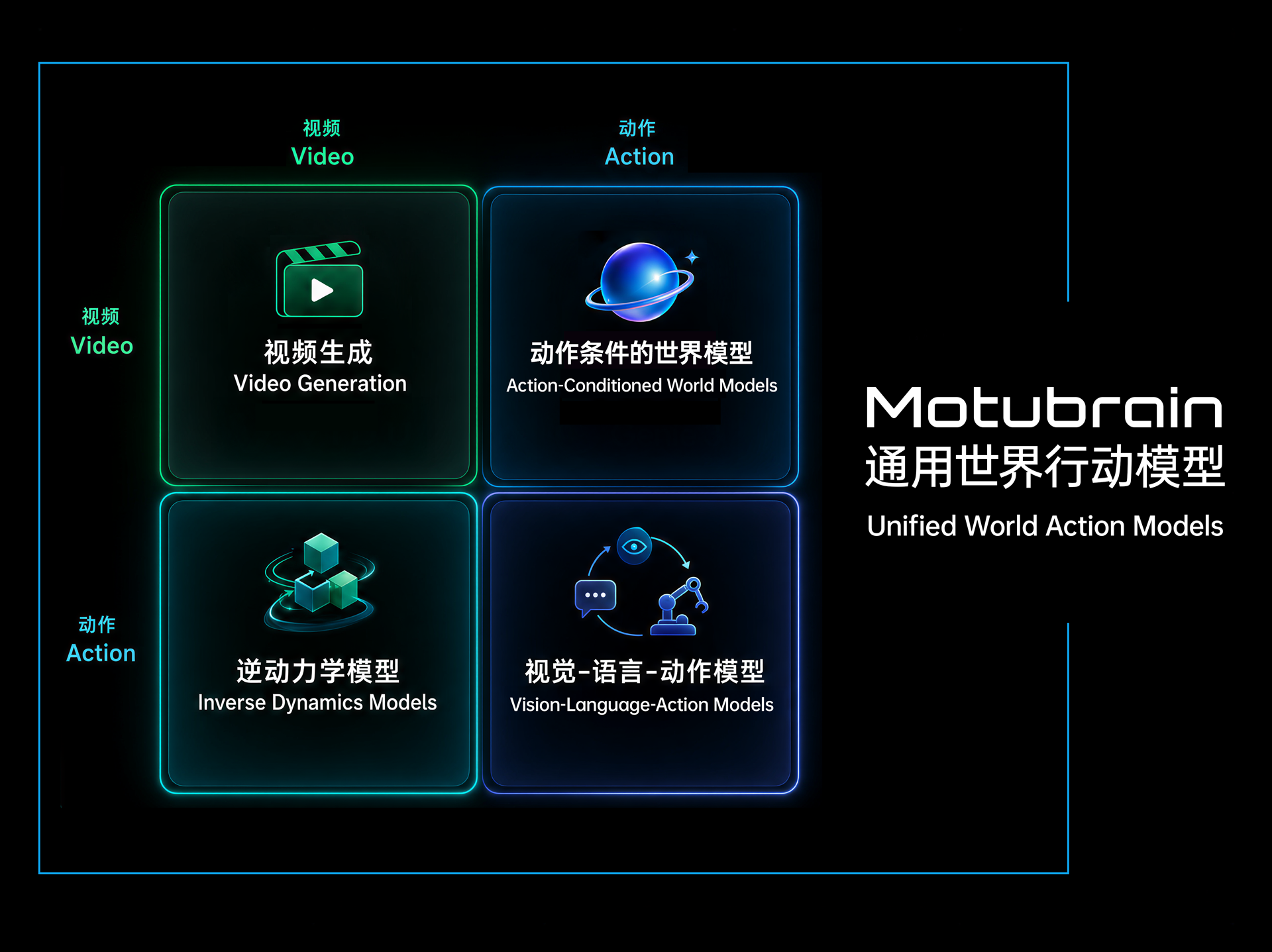
In the evolution of world-model technology, ShengShu Technology has chosen a more forward-looking and challenging route: the World Action Model (WAM).
In December 2025, ShengShu Technology released Motus as open source, proposing and validating the core ideas of World Action Models roughly two months ahead of the broader industry and laying a foundation for General World Action Models.
Building on Motus, the commercial Motubrain model introduces a comprehensive upgrade for real robotic environments, moving World Action Models from technical validation toward a more general and deployable brain for embodied intelligence.
First, Motubrain supports unified modeling across any number of viewpoints. It connects different camera configurations and forms of visual input, removing dependence on fixed viewpoints or sensor combinations and improving adaptability to complex, changing perception conditions in the real world.
Second, Motubrain introduces an independent language-understanding pathway. Language is no longer merely an auxiliary condition attached to visual features; it participates deeply in action generation, connecting high-level semantic understanding with low-level action control and strengthening instruction following.
Third, Motubrain uses a unified action representation to connect different robot embodiments. The model learns transferable action principles rather than the action format of one specific robot, enabling capabilities to be reused and continuously improved across different robot forms.
Fourth, Motubrain offers stronger long-horizon task execution. By combining autoregression with diffusion and using a three-stream Mixture-of-Transformers architecture for language, action, and video, it directly completes sequences of more than ten atomic actions. Complex tasks no longer depend entirely on upper-level decomposition, multiple models, or a fast-slow dual system.
Finally, Motubrain supports real-time closed-loop control for very large embodied models. Cloud-edge-device collaborative inference allows large foundation models to respond in real time inside physical robot systems, bringing higher levels of intelligence into real-world action.
From Motus to Motubrain, ShengShu Technology continues to advance World Action Models: from unified modeling of the world and action to support for multiple viewpoints, embodiments, tasks, and long-horizon execution, moving robots from executing individual actions toward completing tasks end to end.
From Digital Space to Physical Space: A General World Model Strategy Takes Shape
Motubrain is more than a model release. It is a crucial move in ShengShu Technology’s General World Model strategy for physical space.
ShengShu Technology has long developed around Foundation World Models, extending upward into a dual-track system that spans digital and physical space and provides a core architecture for general intelligence.
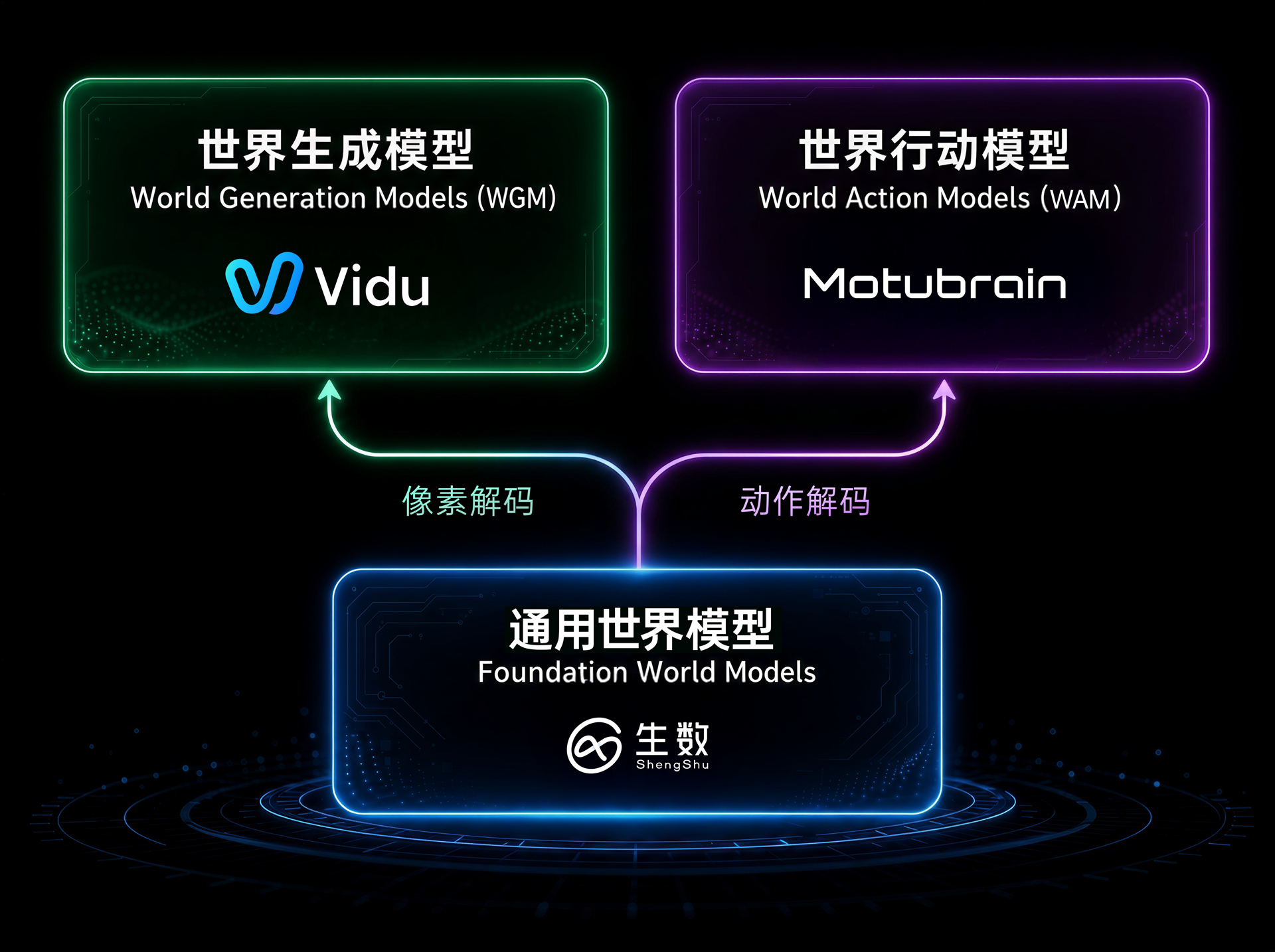
In digital space, ShengShu Technology uses its World Generation Model (WGM) to power the Vidu video model, advancing AI applications in content generation, interaction, and digital productivity.
In physical space, the company develops embodied intelligence through World Action Models (WAM), exploring a unified approach to understanding, prediction, and execution for robots operating in the real world.
The foundation is ShengShu Technology’s multimodal capability stack, built on its globally pioneering U-ViT architecture that combines Diffusion and Transformer models. Through the continued accumulation of visual, auditory, tactile, and other multimodal information, the company is strengthening unified world cognition, modeling, and simulation to provide a shared foundation for intelligent applications in both digital and physical environments.
ShengShu Technology is thereby building a complete loop across understanding the world, generating the world, and acting in the world—turning General World Models into a bridge between digital and physical space.
From Technical Validation to Industry Deployment: Ecosystem Collaboration Accelerates
Technical capability determines the ceiling; deployment depth determines the scale. Motubrain matters not only because it validates the feasibility of a general-purpose robot brain, but also because it is beginning to extend along an industrial path into the real world.
ShengShu Technology has recently formed strategic partnerships with leading embodied-intelligence companies including Anyverse Dynamics, SimpleAI, and Astribot. The partners are collaborating on general-purpose embodied intelligence, foundation-model evolution, multimodal and embodied-data integration, high-quality data systems, and integrated hardware-software optimization.
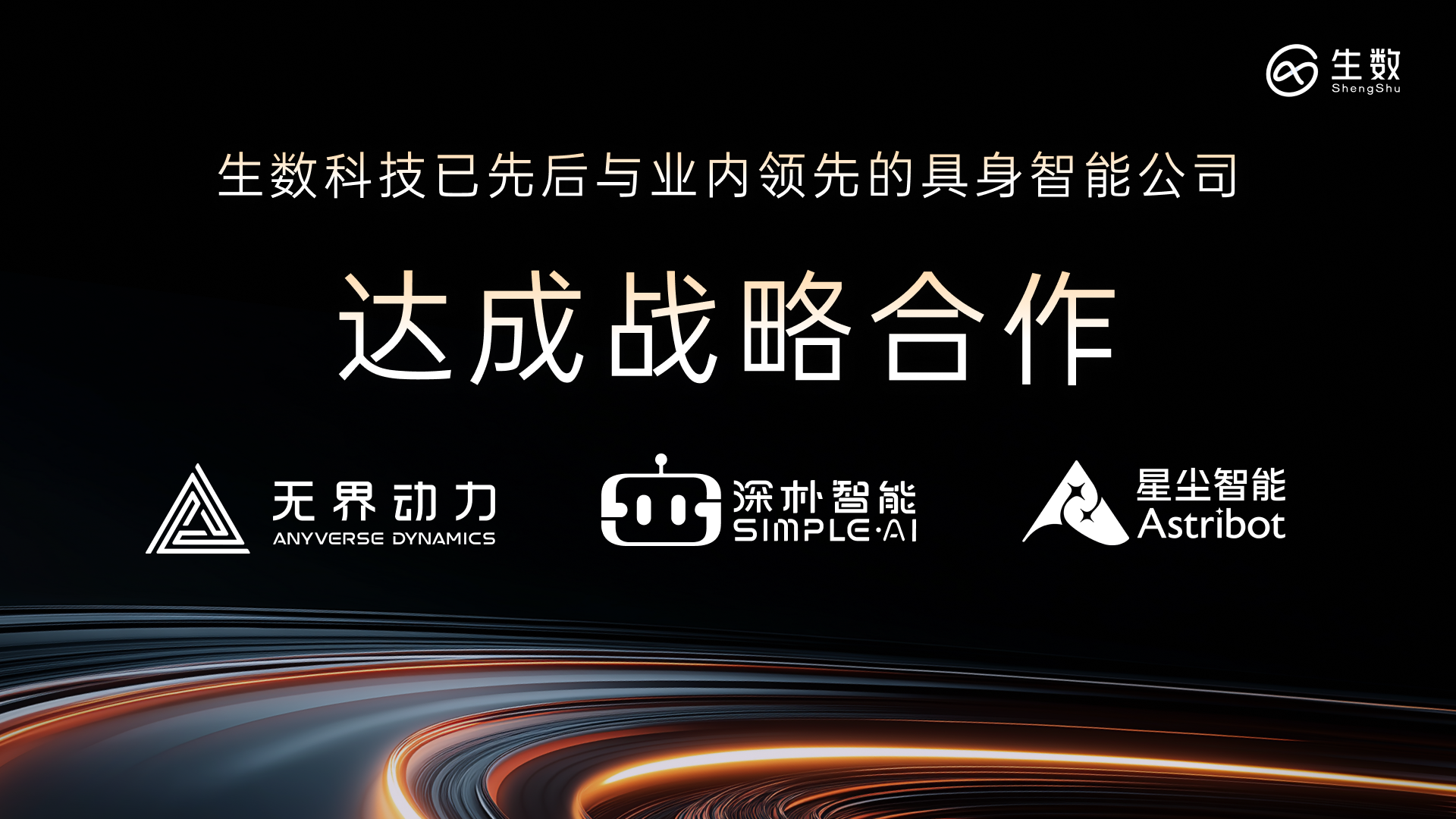
Through continued collaboration with partners across robot hardware, data, scenarios, and applications, ShengShu Technology is using General World Models to redefine the technical foundation of embodied intelligence, deepen integration between world models and robotic systems, and build an open ecosystem for real-world applications.
If Motubrain answers whether a general-purpose brain can work, close collaboration with embodied-intelligence companies further answers how that brain can enter real scenarios.
ShengShu Technology is accelerating a complete chain from General World Models to robot embodiment adaptation and real-world deployment. Motubrain is not only a technology launch or a new benchmark result; it is an important milestone in the company’s move from capability validation to ecosystem development and from technical breakthrough to industrial practice.