
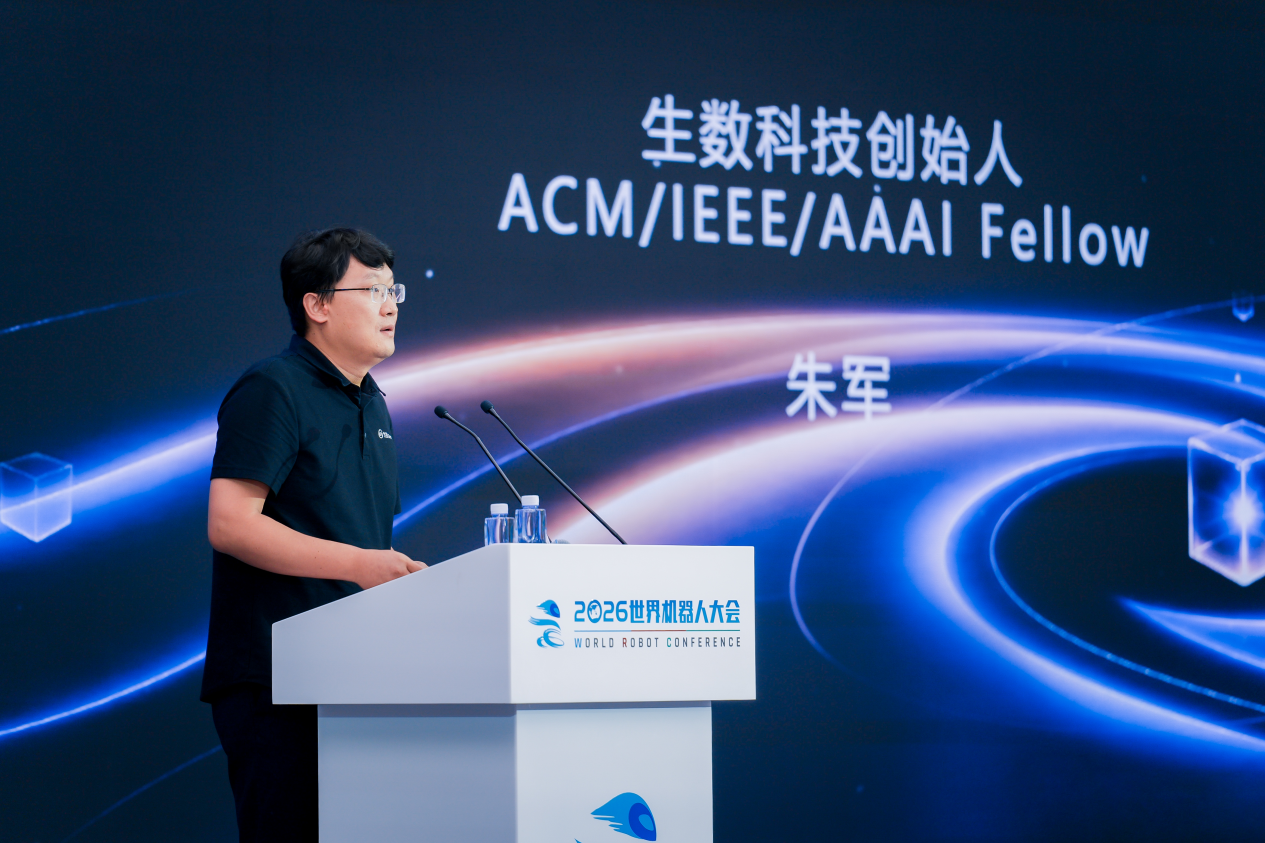
On the afternoon of August 19, the World Robot Conference forum “The Evolution of Embodied Intelligence Foundation Models: From Technical Levels to Industrial Deployment” was held at the Beiren Yichuang International Convention and Exhibition Center. Jun Zhu, founder and chief scientist of ShengShu Technology and an ACM/IEEE/AAAI Fellow, delivered a keynote speech, presented the team’s latest research, and systematically introduced a five-level roadmap for General World Models.
Jun Zhu said: “From the perspective of foundation-model development, we hope to build not merely a specialized model for a particular task or scenario, but a general foundation model that can understand the world, predict the future, and take action.”
Defining General World Models from First Principles
World-model research has extended into video generation, environment simulation, robot decision-making, and action control. Yet the field still lacks a shared understanding of what makes a world model truly general.
When people learn to ride a bicycle or drive a car, their movements gradually become stable and precise. An important reason is that the brain forms an “internal model” of how the world works through continuous interaction with the external world.
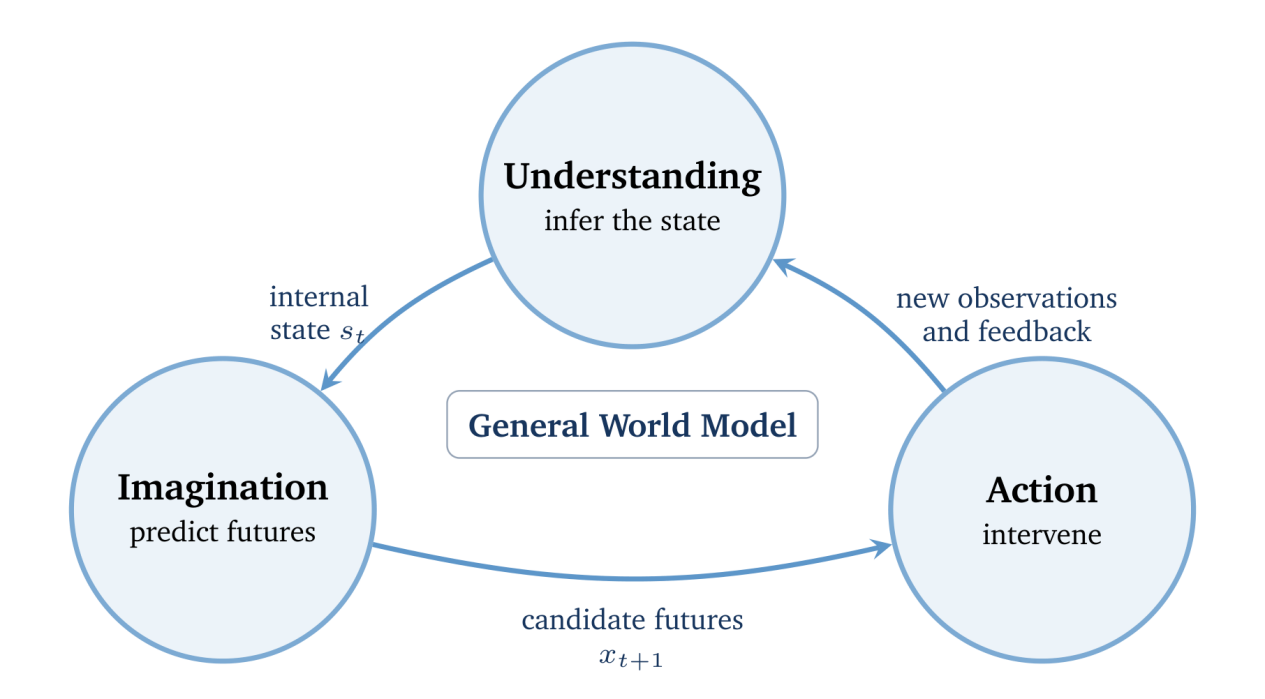
A General World Model likewise requires three connected capabilities:
- Understand the world: perceive the environment and infer its current state;
- Predict the future: anticipate what may happen next and the outcomes different actions may produce;
- Take action: affect the digital or physical environment and use real feedback to correct understanding and prediction.
“A General World Model is not a single generator, simulator, robot action model, or policy model. Nor is it a set of fragmented capabilities or a simple linear chain. It is a closed-loop feedback system in which these three capabilities are coupled together.” Zhu emphasized that action is not only the model’s output: it changes the environment, produces new information, and feeds into the next round of understanding, prediction, and decision-making.
Data, Architecture, and Compute: Three Foundations for General World Models
Building a General World Model still depends on three fundamental ingredients of large models: data, architecture, and compute.
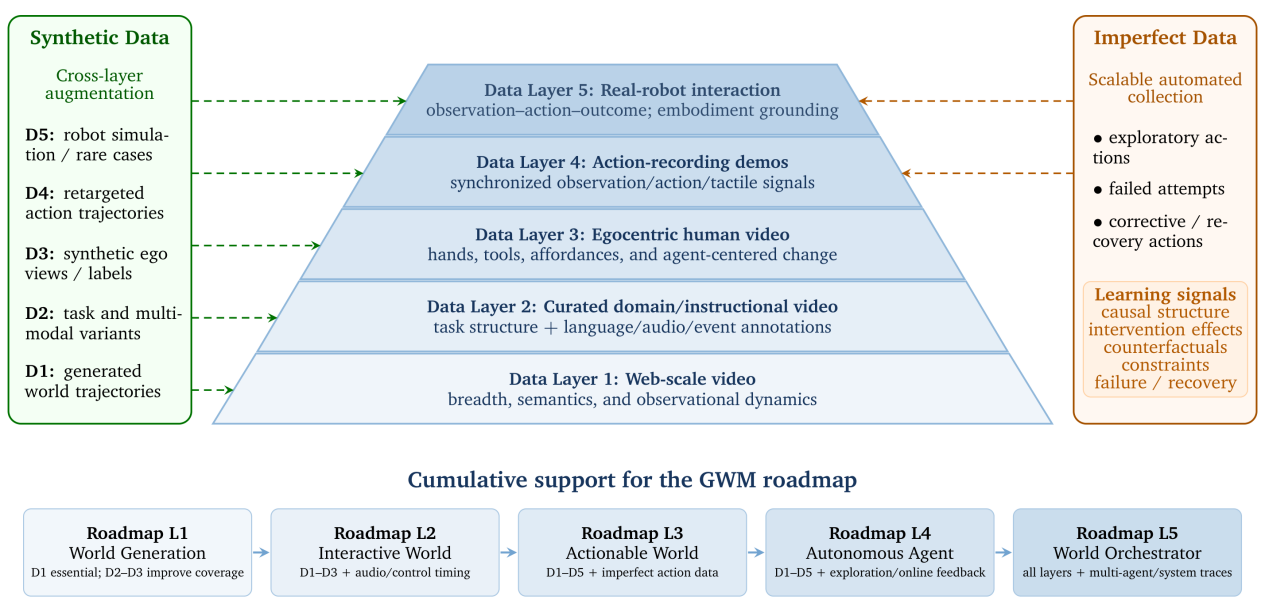
On the data side, a General World Model needs a multi-layer data pyramid that moves progressively from observation toward action: starting with large-scale internet video and expanding to domain-specific video, egocentric human video, human demonstrations with action records, and real-robot interaction data.
The lower the layer, the larger the data scale and coverage. The higher the layer, the scarcer and more expensive the data, but the more directly it connects tasks and actions to physical outcomes. Synthetic data can run through every layer of the pyramid. “Imperfect data” also has important value: failed attempts, corrective actions, and recovery processes all contain useful learning signals that help robots learn how to recover from failure.
At the architecture level, a General World Model must process different modalities, including images, video, language, and robot actions, in a unified way. Mixture-of-Transformers (MoT) assigns dedicated parameters to different modalities and uses shared attention for cross-modal interaction, allowing environment understanding, world-state prediction, and action generation to work together in one model. ShengShu Technology’s World Action Model Motubrain is built on this architecture, unifying understanding, prediction, and action while improving the use of heterogeneous data and cross-task transfer.
Compute affects both large-scale pretraining and real-time deployment. Offline video generation can tolerate some waiting, but real-time interaction and robot control must predict and decide before the environment changes. Training infrastructure, inference acceleration, model distillation, and efficient attention are therefore essential supports for bringing General World Models into practical use.
How Do General World Models Advance? A Five-Level Roadmap
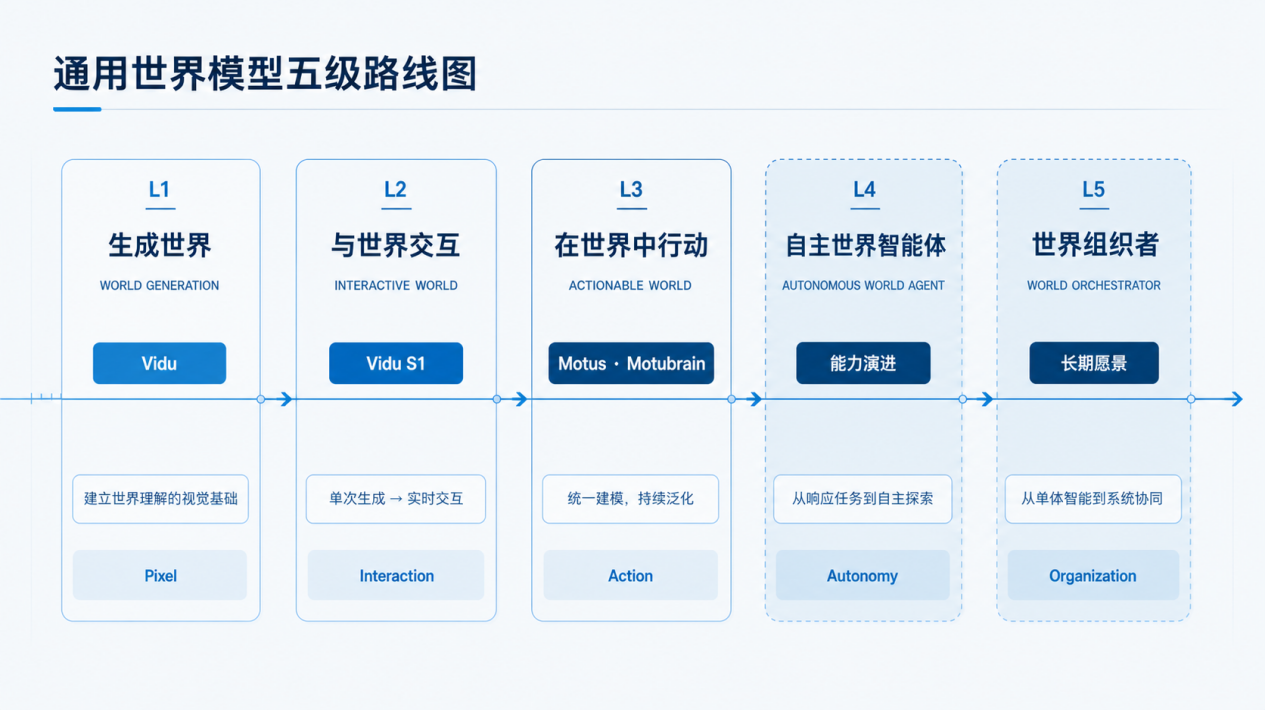
Starting from the goal of a general foundation model, General World Models can be divided into five progressively evolving levels. They are not isolated product directions, but a process in which the model’s autonomy grows as its understanding of and interaction with the world deepen. Over the past several years, ShengShu Technology’s research and deployment practice has covered the first three levels.
L1: World Generation
The first step is for a model to learn how to generate coherent processes of world evolution. Video is the most typical medium at this stage: it helps the model learn about objects, motion, spatial relationships, and temporal change, laying the foundation for deeper understanding and prediction.
In 2024, ShengShu Technology launched the Vidu video-generation model, completing an initial implementation of L1 by continuously improving video quality, temporal consistency, and the modeling of world dynamics.
L2: Interactive World
On top of generation, the model begins to receive real-time input and continuously change subsequent content based on language, speech, or control signals, moving from “one-time generation” to “continuous interaction.”
Vidu S1, released in July 2026, advances this capability to real-time interaction. Users can intervene in the generation process through speech, continuously influence what happens next, and enable the model to evolve the world dynamically in response to external input.
L3: Actionable World
The next step takes the model from the digital world into the physical world. Environment understanding, future prediction, and action generation must now be genuinely unified, so that the model can not only determine what has happened in the world, but also directly generate executable robot actions and continually correct itself using real feedback.
Motus and Motubrain mark ShengShu Technology’s move from video generation toward physical action. Motus was released and fully open-sourced in December 2025; Motubrain, released in April 2026, further unifies environment understanding, world-state prediction, and action-trajectory generation in a single model, moving General World Models from “visual simulation” toward “physical decision-making.”
Compared with Motus, Motubrain improves inference speed by approximately 10 times. When adapting to a new robot embodiment, it requires only 50 to 100 human demonstration trajectories. On the RoboTwin 2.0 benchmark, it achieved a score of 96.1, ranking first. Motubrain has now been validated on nearly ten embodiments, including Galaxy General, Astribot, and Qianxun Intelligence, demonstrating generalization across long-horizon tasks, multi-task scenarios, and different robot forms.
L4: Autonomous World Agent
After gaining the ability to act in the real world, a model must move toward autonomous decision-making: actively perceiving its environment around long-term goals, decomposing tasks, exploring unknown states, and continuously planning actions.
L5: World Orchestrator
At a higher level, the model no longer controls only a single agent. It can coordinate robots, digital agents, people, tools, and other resources to complete more complex task allocation and multi-agent collaboration.
Capabilities build progressively from L1 to L5. Without learning and predicting how the world evolves, it is difficult to form stable, continuous interaction. Without environmental feedback from real action, it is also difficult to develop autonomous learning, long-term planning, and complex coordination.
Toward L4 and L5: Six Challenges Remain
L1 through L3 have now developed into concrete technical practices, but higher-order world intelligence remains out of reach. Video models still need to improve generation quality, controllability, and spatiotemporal consistency. World Action Models must further improve stability, generalization, and execution efficiency in more complex and open real-world environments.
Continuing toward L4 and L5 requires breakthroughs in six key challenges:
- Establish a joint evaluation system covering understanding, prediction, action, and transfer capabilities;
- Learn real physical laws such as contact, friction, force, and the consequences of intervention;
- Build persistent and revisable memory;
- Achieve online learning and self-evolution through real interaction;
- Complete efficient closed-loop deployment under real-world latency and resource constraints;
- Further strengthen safety and controllability.
ShengShu Technology will continue to strengthen the three levels of world generation, interaction with the world, and action in the world, while filling the capability gaps in goal formation, active exploration, continual learning, and long-term memory to lay the foundation for more advanced autonomous world agents. The longer-term goal is to build a general foundation that can continuously understand the world, predict the consequences of different actions, act autonomously under explicit constraints, and keep learning and evolving from real feedback.
When understanding, prediction, and action truly form a closed loop, a world model will no longer be merely a content-generation model or a robot policy for executing tasks. It will become an essential foundation for connecting the digital and physical worlds and advancing toward general embodied intelligence.